Case study · Trading & Performance Systems
QuantXecute
Correctness-first market-data and execution-simulation engine in C++20
The problem
Exchange order-book feeds are incremental and stateful: a missed or misordered update silently corrupts the local book, and everything computed on top of it is wrong. Execution simulation is just as fragile — it is meaningless unless replaying a recorded session produces exactly the same book state and results as processing it live.
What I built
L2 order-book reconstruction
Snapshot + incremental delta processing with price-level updates. The book is a pure state applier; all feed continuity semantics live in a separate sequence validator, so the correctness logic is unit-testable under sanitizers with no UI and no network.
Exchange sequencing integrity
OKX books feeds use seqId/prevSeqId continuity, not dense +1 counters. A snapshot (prevSeqId = -1) establishes the baseline; an update is accepted only if its prevSeqId equals the last accepted seqId. A mismatch invalidates the book, counts a gap and requests a fresh snapshot — the bad update is never applied.
Execution simulator
Simulates market execution against observed L2 depth with sound units: VWAP, basis points and USD cost, sized by notional or base quantity with an explicit taker fee. Simulations refuse to run against an unverified book.
Deterministic record & replay
Recorded market events replay through the same validation/application path as live data. The parity invariant — identical event sequence, byte-identical order book, identical execution results — is enforced by qx.parity_test, a required member of make verify.
Resilient feed client
The feed client drives reconnect with backoff, staleness detection and gap-triggered resync over a transport-agnostic FeedSource; the OKX source implements the production TLS WebSocket session. Reconnect policy lives in one state machine.
API & engineering console
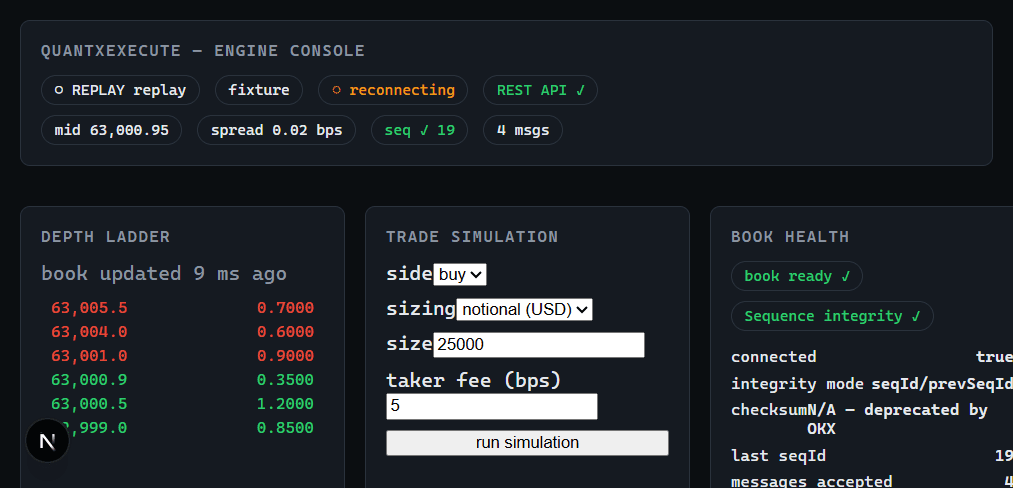
REST endpoints for /health, /book and /simulate plus a 1 Hz WebSocket /events stream. The Next.js dashboard exposes feed and book health — including parity status — and reports the engine as unavailable instead of rendering placeholder data.
Engineering decisions
Sequence correctness over naive counters
seqId may jump forward arbitrarily, repeat on empty keepalives, or move lower on a maintenance reset — none of those are false gaps. Continuity is judged solely on prevSeqId matching the last accepted seqId, with keepalive, stale-reject and gap-resync handled as distinct verdicts.
Explicit integrity policy
OKX deprecated the books checksum on 2026-06-23 — the field still arrives but is fixed to 0 — so the engine runs OKX under an explicit SequenceOnly integrity policy and never advertises CRC32 as a live guarantee. Checksum-capable feeds can opt into SequenceAndChecksum, where a genuine mismatch takes the book offline until a fresh snapshot recovers it.
One code path for live and replay
Replay drives the same decoder, validator, book and execution simulator as the live feed — there is no separate demo implementation. The parity test ships with negative controls: dropping one delta or tampering one prevSeqId must break parity.
No fake availability
If live mode cannot connect, /health reports connected: false and bookReady: false, and /simulate refuses with 503. The server never silently switches between fixture replay and live data, and the dashboard says unavailable rather than showing a stale book.
Architecture
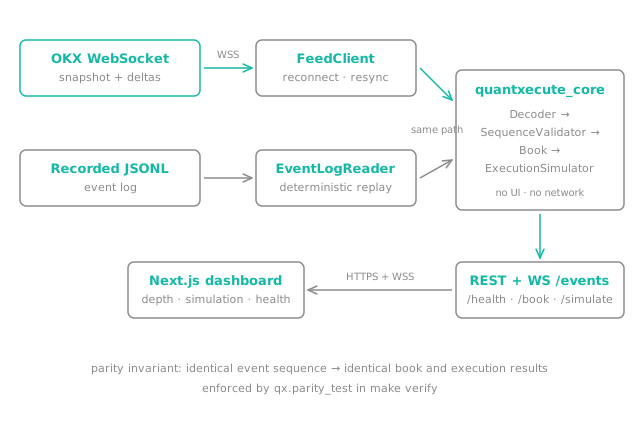
Live OKX WebSocket or a recorded JSONL log drive the same decoder → sequence validator → book → execution simulator path; the REST + WebSocket API serves the Next.js dashboard
Testing & CI
make verify runs three gates in a Linux container: an ASan+UBSan instrumented build of the production libraries under the full CTest suite, a ThreadSanitizer pass, and clang-tidy over core, feed and server — all enforced by GitHub Actions alongside dashboard tests, typecheck and build, plus a Docker replay smoke test. Benchmarks are measured, not claimed (GCC 12, Release -O2): applyDelta at p50 122 ns across 200k ops on a 5,000-level book, and deterministic replay sustaining ~239,656 events/s over a 100k-delta recording.
Screenshots
Engine console
Replay mode against the real engine: depth ladder, a $25,000 simulated buy with VWAP and bps cost, and live book-health counters
Algorithms & performance background
The habits behind this engine come from competitive programming: reasoning about invariants, edge cases and complexity before writing code. That background carries directly into correctness-sensitive C++ systems — sequence validation, deterministic replay and sanitizer-clean concurrency are the same discipline applied to market data.
C++20 / WebSocket / CMake / ASan+UBSan / TSan / Next.js